
The action raises compliance risks for MRO companies, freight forwarders, aircraft brokers and parts suppliers in the UAE, Türkiye, Malaysia and other transit markets.
The U.S. Treasury Department has broadened its campaign against Iran’s aviation industry, sanctioning 27 Iranian airlines and nine foreign companies and individuals accused of supporting aircraft procurement, maintenance and cargo operations.
The Sept. 8 action shifts attention from Iranian carriers to the network of maintenance providers, parts suppliers, aircraft brokers, general sales agents and freight companies that sustains their operations. Treasury identified support activity in the United Arab Emirates, Türkiye, Malaysia, Kazakhstan and the United Kingdom.
For aviation companies in those markets, the principal risk lies not only in servicing a named Iranian airline. It also arises from aircraft and parts transactions structured through temporary owners, free-zone companies, foreign registrations and logistics intermediaries that conceal the Iranian end user.
“Let this be a warning to anyone doing business with Iran’s remaining airlines, all of which we sanctioned today: You are at risk of being cut off from the global financial system,” Treasury Secretary Scott Bessent said in the department’s announcement.
The action is the first use of the aviation-sector authority Treasury established Aug. 24 under Executive Order 13902. That authority permits sanctions against companies operating in Iran’s aviation sector and persons that knowingly conduct certain significant transactions involving goods or services used by the sector.
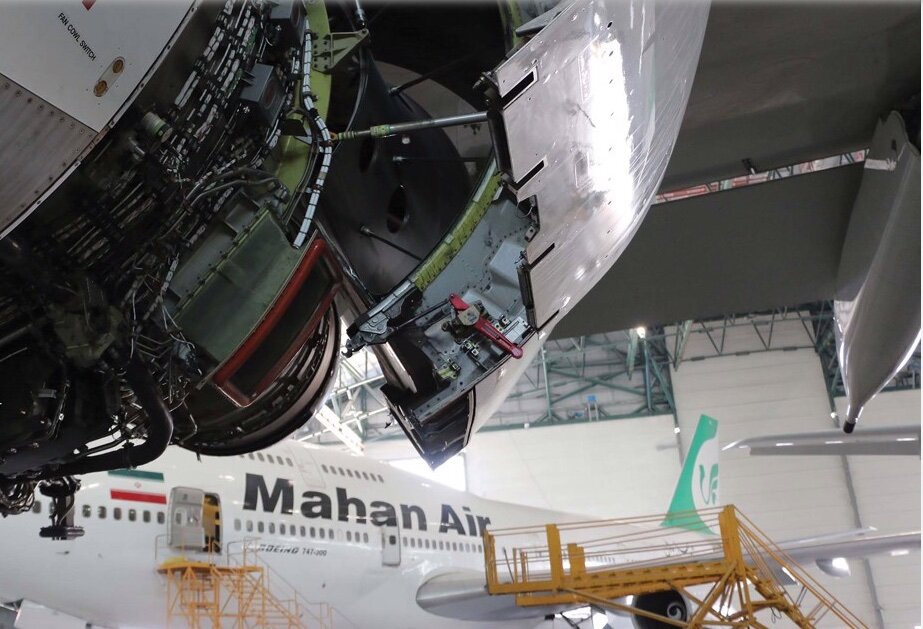
Treasury said Mahan Air acquired at least three Boeing 777 aircraft during the summer through intermediaries in the UAE, Oman and Türkiye. The aircraft came from a retired fleet and received temporary registrations before their transfer to the sanctioned Iranian airline.
OFAC designated UAE-based ECT Aviation Support LLC and Türkiye-based Sky Phoenix Hava Yollari Tasimaciligi Ticaret Limited Sirketi for supporting Mahan Air. It also sanctioned ECT Aviation Support’s owner, Ibrahim Ali Mohamed Mohamed Mahran; a related United Kingdom company; and UAE-based Aerobravo Airplane Management and Operation LLC.
The department separately targeted companies that allegedly supplied cargo or general sales agent services to Mahan Air. They include Türkiye-based S Sistem Lojistik Hizmetler Anonim Sirketi and Mes Cargo Transportation Tourism and Foreign Trade Limited Company, Malaysia-based Icargo SDN BHD and Kazakhstan-based Tour Invest LLC.
Treasury accused the Turkish companies of coordinating shipments, including unmanned-aircraft components and industrial equipment destined for Iran. It said Icargo arranged shipments of U.S.-origin parts on Mahan Air’s behalf.
The designations require companies to look beyond the operator named on an aircraft or shipment. Relevant parties may include the aircraft owner, lessor, broker, maintenance provider, registration agent, cargo agent, insurer, bank and ultimate operator.
The action is unlikely to remove a large, identifiable source of revenue from major maintenance, repair and overhaul companies in the UAE, Türkiye or Malaysia. No reliable public data show how much work their formal MRO sectors perform for sanctioned Iranian or Russian aircraft.
Large MRO operators rely on Western manufacturers, technical data, parts, insurers and regulatory approvals. Those relationships give them strong incentives to avoid direct work for blocked airlines.
Smaller component shops, traders, brokers and freight companies face greater exposure. Aircraft procurement networks often divide a transaction among several service providers, none of which may see the complete ownership, payment and delivery chain.
MRO providers should therefore identify the aircraft’s serial and registration numbers, ownership history, prior operators and intended use. They should also establish the origin and export classification of parts, the source of technical data and the identity of any company paying on the customer’s behalf.
Repeated changes in ownership or registration, unexplained movement through several jurisdictions and the use of recently formed aviation or general-trading companies warrant further review.
The UAE presents particular exposure because it combines substantial MRO capacity with aircraft finance, leasing, free zones and international logistics. Türkiye’s proximity to Iran and its role in regional passenger and cargo operations create similar risks. Malaysia has less direct exposure but remains relevant as an Asian center for component maintenance, parts distribution and freight forwarding.
The Financial Crimes Enforcement Network issued a companion alert asking financial institutions to identify and report transactions associated with Iranian aircraft procurement.
The indicators include:
Recently formed aviation, technology or logistics companies with opaque ownership and little commercial history;
Companies using residential addresses, shared post-office boxes or addresses associated with numerous similar entities;
Aircraft that have remained in storage, changed registration repeatedly or passed through layered owners in several countries;
Customers claiming OFAC or Commerce Department authorization without providing it;
General-trading companies in free zones purchasing aircraft parts outside their normal business;
Orders placed in one country for delivery to a freight forwarder in another; and
Logistics companies that also serve sanctioned Iranian or Russian airlines.
FinCEN asks financial institutions filing related suspicious activity reports to use the term “FIN-2026-IRANAIR.”
The alert does not itself prohibit a transaction. It is likely to produce more inquiries, delayed payments and rejected transfers when banks cannot establish the aircraft’s end user or the commercial purpose of a parts shipment.
The alert's reference to Russian airlines also links two areas of aviation compliance. Support for Russian carriers may be restricted under Commerce Department export controls even when the carrier is not blocked by OFAC.
BIS has stated that servicing certain aircraft operated in violation of Russia export controls may itself violate the Export Administration Regulations without authorization.
Banks and service providers may therefore examine a company’s work for Russian aviation when assessing an unrelated transaction with possible Iranian exposure.
OFAC also indefinitely suspended authorizations for certain payments connected with overflights of Iranian airspace, aircraft-safety activity, bunkering and emergency repairs. It suspended General License J-1, which had allowed eligible foreign-registered civil aircraft containing specified levels of U.S.-controlled content to enter Iran temporarily.
Iran General License DD permits transactions ordinarily incident and necessary to wind down activity previously authorized under the overflight, bunkering and temporary-sojourn provisions through 12:01 a.m. Eastern daylight time on Sept. 23. It does not authorize new business.
Counter Terrorism General License 37 provides the same deadline for winding down qualifying transactions involving ECT Aviation Support, S Sistem and Mes Cargo, including entities they own by at least 50%.
Payments to a blocked person under either license must enter a blocked, interest-bearing account in the United States. The licenses do not authorize transactions prohibited under another sanctions program.
Aircraft operators and service providers should halt new activity that depended on the suspended permissions, identify open transactions and determine whether a wind-down license applies. Safety-related activity falling outside those licenses may require specific authorization from OFAC and, where U.S.-controlled aircraft, parts or technology are involved, the Commerce Department.
The action places regional support operations at the center of Treasury’s aviation campaign. MRO companies and freight providers must now treat aircraft ownership, registration history, payment routing and ultimate use as core sanctions-screening data rather than operational details.


Comments
No comments on this item Please log in to comment by clicking here